Apr 20

4 Tips To Improve Your Moguls

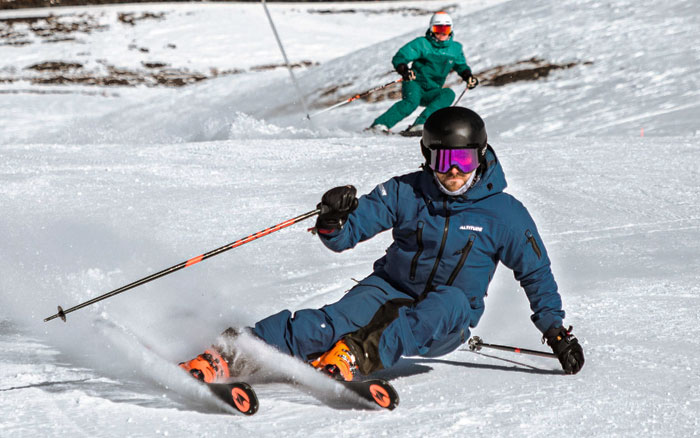
We’ve got a series of articles on moguls or bumps skiing to come out this week. We thought we’d start off with some simple tips to improve your moguls from Jon West. Video and more technical bumps articles to follow!

Fancy some bumps?


  1. Choice of line

There are many lines that you can choose to ski in the bumps. You can ski in the valleys or troughs. This is the line water would take if you poured it down the slope. The other option is to take the rounder line turning on top of the bumps. Both may be needed; and which line you choose will depend on the type of bumps. Experiment with different lines!

Looking ahead

  1. Look ahead

If you are not looking ahead then you are not going to be able to plan and choose a good line. Looking further down the slope will give you a better flow and rhythm, and help you to have “quick feet” – which is vital in the bumps.

Tip : Don’t look at the turn you are on or you will be too late for the next one! Look 2 or 3 turns ahead.

  1. Quick feet

Having the ability to move your feet quickly is a key skill. You will need to stay centered to enable your legs to turn. Try to reach forward with your pole plant to re-center and to stop you from getting in the back seat.

Tip: practice quick short turns on the piste to prepare you to move quickly when you get into the moguls.

Bend and...

  1. Bend and Stretch

As the terrain changes underneath you will need to flex and extend your legs in order to keep your skis in contact with the snow and have a smoother ride! Allow your legs to bend on the upside of the bump as the bump “pushes” against you. Then on the backside, as the bump falls away, extend your legs and get the tips of your skis down to keep contact with the snow.

...Stretch!

Happy hot dogging

Apr 02

Walking All Day

Sorry for the radio silence on the blog front – I’ve been away in Chamonix this week. To kick the blog back off here is a re-post of an article. I’m not sure who the original post is by, but it’s too beautiful to miss. If anyone knows where the atricle is from or knows anything about Simon Beck let us know.


Artist Simon Beck must really love the cold weather! Along the frozen lakes of Savoie, France, he spends days plodding through the snow in raquettes (snowshoes), creating these sensational patterns of snow art. Working for 5-9 hours a day, each final piece is typically the size of three soccer fields! The geometric forms range in mathematical patterns and shapes that create stunning, sometimes 3D, designs when viewed from higher levels.


How long these magnificent geometric forms survive is completely dependent on the weather. Beck designs and redesigns the patterns as new snow falls, sometimes unable to finish a piece due to significant overnight accumulations. Interestingly enough, he said, ‘The main reason for making them was because I can no longer run properly due to problems with my feet, so plodding about on level snow is the least painful way of getting exercise. Gradually, the reason has become photographing them, and I am considering buying a better camera.” Spectacular art for the sake of exercise!

Mar 19

Gearing Up For The Freeride World Tour In Verbier

Here’s a little video Altitude Director and resident legend Andre Sommer made when he was judging the Freeride World Tour at the last event. Lots of coverage of FWT in Verbier to come this weekend – for more info follow us on twitter.

Mar 15

Backside Shifty

Backside shifty by Jan Schlimmer


1. Take off on a flat base, with your shoulders parallel to the board.

2. Turn your board backside 90′, and your shoulders in the other direction.

3. Keep your body as tight as possible in the air to prevent flapping of the
arms or legs.

4. Release the tension in your body, let the board come back in the riding direction, your shoulders should move back in their original position, or further (back towards the valley).

5. Land it, ride it out, and then relax.


Follow us on facebook and twitter for more updates.

Mar 13

Patrouille Des Glaciers

Bonjour,

Montée de la Rosablanche. Des spectateurs admirent l'exploit des sportifs.

Je m’appelle Martina et suis monitrice à l’école de ski Alitude de Verbier. Avez-vous deja entendu parlé de la Patrouille des Glaciers, cette course mythique, organisee par l’armée Suisse, qui relie Zermatt à Verbier ?Ce sera sa 15eme édition cette année, du 25 au 28 avril 2012 avec en programme:

Zermatt à Verbier 110 Km effort – Dénivellation: +3994 m, -4090 m
Arolla à Verbier 53 km effort – Dénivellation: +1881, -2341

La Patrouille des Glaciers est une course exigeante durant laquelle il s’agit de rallier en une étape Zermatt à Verbier ou Arolla à Verbier selon sa catégorie. Cette épreuve se caractérise par sa longueur, son altitude moyenne élevée et le profil de son itinéraire. Pour pouvoir y participer, il faut non seulement posséder une réelle expérience de la haute montagne ainsi que la maîtrise de ses conditions extrêmes, mais aussi une préparation morale et physique spécifique et minutieuse.
La Patrouille des glaciers fut conçue comme un exercice d’endurance pour les soldats helvétiques durant la seconde guerre mondiale. Elle perdura jusqu’en 1949, année qui vit une patrouille disparaitre dans une crevasse, ce qui provoqua l’interdiction de la course. Mais, en 1984, celle-ci a été rétablie, et de nombreuses patrouilles restent composées de militaires.

Plus de 4300 personnes, dont 777 femmes, ont pris part à l’édition 2010 de la Patrouille des Glaciers (PDG). Victime de son succès, la PDG a dû refuser quelque 2000 intéressés.
Cette épreuve se dispute par patrouilles civiles ou militaires de trois concurrents. Elle est ouverte à des formations masculines, féminines ou mixtes.

Le record masculin a été battu en 2010 avec une course réalisée en 5h52mn, soit 26 mn de mieux qu’en 2008…..

Les vainqueurs 2008: Florent Troillet, Didier Moret and Alexander Hug

A la sortie de Zermatt, quelque 2 000 mètres de dénivelés attendent les participants, qui doivent grimper d’abord à pied, puis gravir les pentes enneigées et glacées en fixant sous leurs skis des peaux de phoque adhérant à la neige. Ils devront également franchir plusieurs sommets de plus de 3 000 mètres, notamment Tête-Blanche (3 650 mètres), le col de Bertol (3 268 mètres) et Rosablanche (3 160 mètres).
S’éclairant grâce à une lampe frontale, skis sur le dos, casque sur la tête, munis de piolet, pelle, sonde et boîtier détecteur d’avalanche, les alpinistes partent du village de Zermatt (ouest), pour la course de 53 kilomètres. Une épreuve plus courte, de 26 kilomètres, part également du village voisin d’Arolla dans la nuit.
Le chef de chaque patrouille, composée de trois randonneurs, porte en outre une corde de 30 mètres car à certains endroits, les alpinistes skient encordés pour éviter de tomber dans une crevasse, difficilement détectable dans le noir.

Le champion olympique de descente, Didier Défago, en compagnie du nouveau patron de la Patrouille des Glaciers

Cliquez sur ce lien, vous verrez deux super videos de la course :
http://patrouille-arfec.ch/la-course/

A tres bientot,

Martina

Feb 27

Trick Tips: How To Do A Nollie

1. Keep a straight line at a low/controlled speed. On a flat base, flex and get ready to pop.

2. To use the nose of your board as a spring, lift up your back leg and transfer your body weight on to the nose.

3. Pop off your nose and bring your front leg up. Get as high as you can, bring your knees up to your chest.

4. Keep your board leveled and prepare to land on both feet at the same time.

This is a very fun trick to do off rollers, roads and onto boxes. Once you have mastered your Nollies try doing Nollie 180’s.
Hope you have lots of fun with this trick and see you in Verbier!

Sofia, Altitude Snowboard Instructor

Feb 24

How To Get Fit For Skiing

We all want to get the most out of our time on the mountain, whether it’s your first day on snow or you’re doing the Haute Route, and being physically fit is a big part of this. In this article we’ll look at some of the basics for preparing your body for snowsports and in particular skiing.

How hard can it be...

Tailor Your Training To You

As with any fitness program, we need to make our training match our needs but also our ability. If you don’t do a lot of exercise then just making time for a regular 10 minute run will improve your time on the hill. Similarly, if you regularly fitness train then a more focused regime, perhaps involving plyometrics and sprints (see below), will improve your ski fitness. Be honest with yourself about what you need to do.


Think Long Term

Again, as in any training regime it is continous work over a long period of time that yields results. Sadly there are no magic exercises or workouts that you can do for a week to get ready for skiing. However, by making fitness training part your daily life you’ll be ready for Mont Fort.


Skiing Specifics

This is the part everyone is really wanting to read. While there are no magic bullets, we can make our training time more efficient and targeted by working the right body parts in the right way

Legs: It goes without saying that your legs are doing most of the work in skiing. So we need to target our leg muscles in our workouts. This includes the quadraceps and glutes with exercises such as squats and lunges, as well as  the hamstrings, which can be worked on a leg curl machine or with medicine ball curls http://health.howstuffworks.com/wellness/diet-fitness/exercise/leg-exercises-tb2.htm
Power (explosively moving weight) and power endurance are key elements in skiing. Rather than doing a long jog, try lots short sprints (5 to 10 sprints of 30 seconds to 1 minute); this way you’ll focus on building up the right sort of endurance. Plyometrics, which involves performing explosive, jumping movements, is the current choice of champions for power training in the off season. Be warned that this is only recommended for regular gym goers. A great article on on plyometrics can be found here http://www.sport-fitness-advisor.com/plyometricexercises.html
As well as exercises there is information on how to build a safe training program.

Core: Your core (the muscles around spine including the lower back and abs) is also a key area. It’s from here that our balance arises. Common exercises are the plank, which are great because the effort can be steadily increased by holding the position for longer or taking a limb out of the equation. For more information on core training see: http://www.sport-fitness-advisor.com/core-strength-training.html


Lastly, if you need some motivation for training, see World Champion Didier Cuche in this video (plus the music is great)

http://www.youtube.com/watch?v=EzCbfeeZPf0&feature=share


Ross

Feb 16

Dress For The Weather

Europe has been experiencing a very cold season this year with temperatures going as low as -18 degrees C in resort and you often experience these sorts of temperatures when skiing in North America. It is hugely important to make sure your kids stay warm both for safety and enjoyment  reasons. Children loose heat quicker than adults and their energy levels will suddenly drop. If they go from being lively to quite, more withdrawn, struggling down a piste you expect them to be fine on or they keep falling over on easy runs, check on how warm they are and go for a break.

Here are some tips for keeping them (and you) warm.

Small Kids (3-5 year olds) – often they won’t tell you they are getting cold until they are very cold. Keep checking to see how warm their hands are.

Layering – Several layers of thinner clothing are better than one thick one as it is easier to adjust for temperature changes throughout the day. Don’t wear cotton as once it is damp it losses a lot of its thermal properties.

Ski Boots – Make sure they are properly dried out every evening, ideally use boot dryers over night, alternatively take the inner boots out and place them on a radiator (make sure you put them back in the right boot) or use a hair dryer.

Mittens – are warmer than gloves and inner thermal gloves can be used for more warmth.  Again make sure they are dried out properly overnight. You can get ones that have a pocket that you can fit a hand warmer in. Hand dryers in the toilets up the mountain are useful for warming mitts up.

Frost Nip – regularly check for frost nip, small white patches on exposed skin usually on the nose, cheeks or ears. Skiing fast increases the chance of it happening due to windchill, ski lots of short turns to reduce the speed and to keep everyone warm. A neck warmer/face mask helps to prevent it but keep checking underneath this to be sure. Make sure some one checks you as well. If you see it get inside and warm up immediately as the next stage is frost-bite, which will need medical attention.

Stay Warm And Stay Safe!

Feb 09

The St Bernard Dog

Bonjour,


Je m’appelle Martina et suis monitrice à l’école de ski Alitude de Verbier.
Saviez-vous que le Saint-Bernard est considéré comme chien national suisse ?
Voici quelle est son histoire :

Il y a 2500 ans que le Saint-Bernard aurait trouvé ses origines en Asie. Son introduction en Europe se fit avec le commerce et les différentes guerres. Sa véritable histoire commence dans les Alpes, en 1695 au Monastère du Grand Saint-Bernard.

Vers 1050, Saint Bernard d’Aoste, archidiacre d’Aoste, voyant régulièrement des voyageurs arriver terrorisés et détroussés, décide de mettre fin aux brigandages dans la montagne. Dans ce but, il fonde, au sommet du col du Grand-Saint-Bernard, l’hospice qui portera plus tard son nom. 


L’hospice au sommet du col du Grand- Saint-Bernard à 2469m d’altitude a été fondé au XIe siècle pour offrir un refuge aux voyageurs et pèlerins. Dès le milieu du XVIIe siècle, les moines s’entourèrent de grands chiens de type montagne destinés à la garde et à la défense.

Bientôt ces chiens furent utilisés pour accompagner les voyageurs et surtout pour retrouver et sauver ceux qui s’étaient égarés dans la neige et le brouillard. Les chroniques publiées dans de nombreuses langues sur la manière dont ces chiens avaient sauvé un grand nombre de vies humaines de la mort blanche, et les récits des soldats qui, en 1800, franchirent le col avec l’armée de Bonaparte répandirent au XIXe siècle la renommée du Saint-Bernard partout en Europe. Et c’est ainsi qu’il devint le prototype du chien de sauvetage.

Le plus célèbre des Saint-Bernard, appelé Barry, est né en 1800. Barry, signifie “petit ours” en patois bernois. En 10 ans, il sauva 40 personnes, dont un enfant qu’il aurait hissé sur son dos, jusqu’à l’Hospice. A présent, à l’hospice, le  chien le plus beau de la meute s’appelle Barry. En 1814, il fut blessé et emmené à Berne pour y être soigné, mais sans aucun résultat…

En 1855, afin de résoudre des problèmes de consanguinité, les moines ont croisés les chiens avec des chiens Terre-Neuve ; Une deuxième race de Saint-Bernard est née :  le Saint-Bernard à poils longs. A présent, il existe deux variétés de Saint-Bernard : celle à poil long et celle à poil court. L’élevage a été transféré à une fondation, la fondation Barry située à Martigny, en 2004. Cette fondation s’est engagée à maintenir la race et de laisser des chiens l’été à l’hospice. 

Pour ceux qui se posent la question du tonnelet autour du cou du chien :
Un jour, un berger mis autour du cou de son chien une gourde ; c’est de là que lui est venu l’idée de fabriquer un tonnelet en bois accroché au cou du chien avec une boisson chaude à l’intérieur, des tisanes  et non de l’alcool. Mais, on s’aperçut vite que le tonnelet gênait beaucoup le chien durant ses déplacements dans la neige.

Au plaisir de bientot vous retrouver sur le blog d’Altitude.

Martina